Accessible English text for page 1
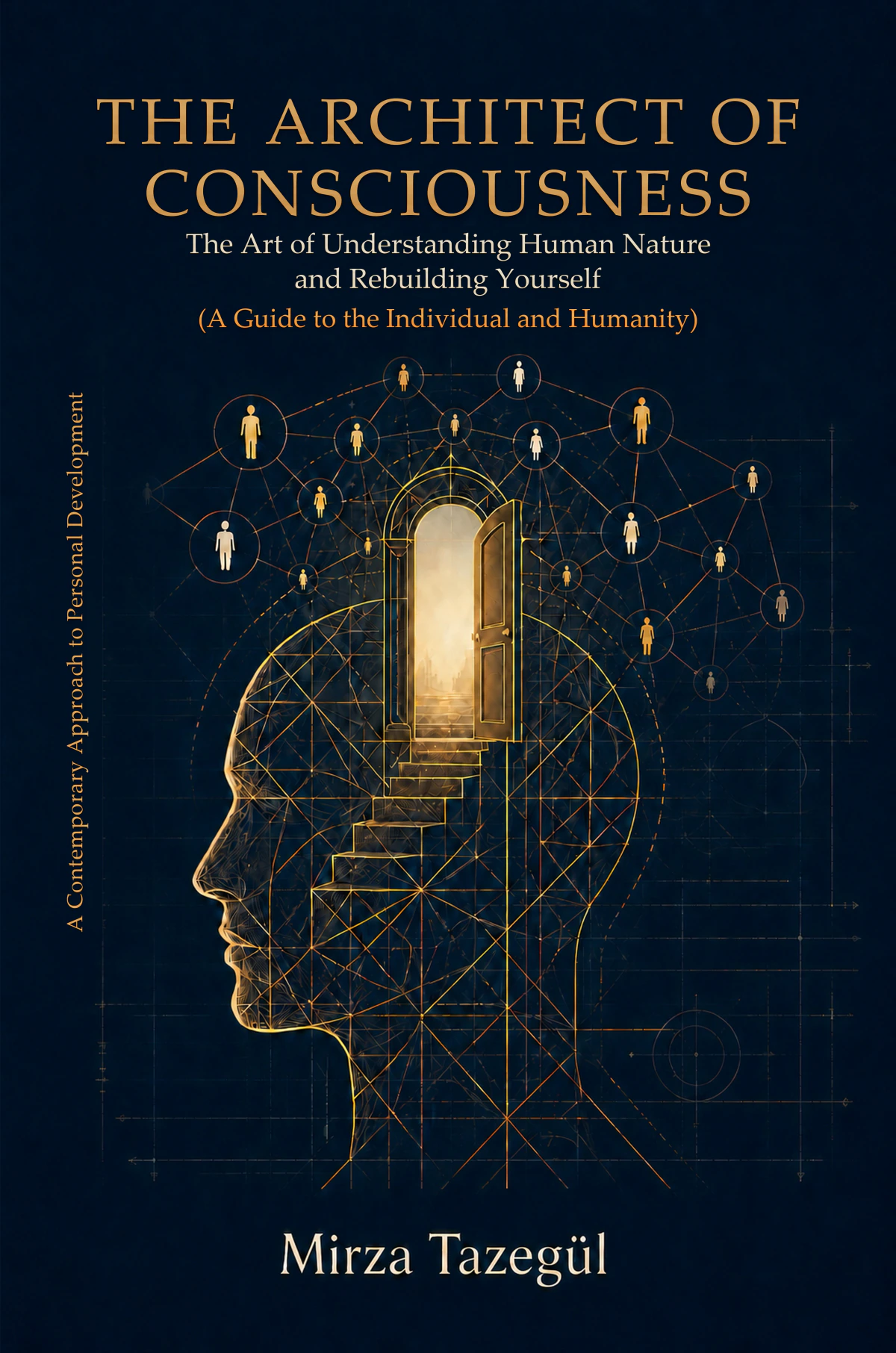
THE ARCHITECT OF CONSCIOUSNESS
The Art of Understanding Human Nature and Rebuilding Yourself
(A Guide to the Individual and Humanity)
Mirza Tazegül
“Chance favors only the prepared mind.” — Louis Pasteur
PREFACE
This book is not an answer; it is an invitation. I know that the human mind, the emotions,
and a life cannot be fitted into a single formula. And I know this, too: when people find their
own rhythm, they can open a path even in the middle of chaos. The Architect of
Consciousness was written in that belief.
We live in an age where speed is worshipped, our attention is put up for sale, and noise lays
siege to the mind. We are tired. And this weariness is not only of the body; it is a weariness
of the mind, of meaning, of our sense of direction. Thoughts multiply, but they do not
deepen.
That is why we need a new language and a new map. This book was not born to hand you
ready-made formulas, but to offer you a compass you can use as you build your own way.
I have brought together the scientific insights of psychology, the timeless questions of
philosophy, stories drawn from life, and small, workable steps. Because I believe change is
born less of great leaps than of the accumulation of small, conscious steps.
As you turn these pages, you will find three main veins running through them: silence, which
slows the mind; rhythm and ritual, which help you come to know yourself; and contribution
and legacy, which give a life its meaning. None of these promises a miracle on its own.
Together, though, they can open a new way of seeing, a deeper breath, and a direction in
which to build a life of your own.
The personal stories in this book that appear without names or sources are representative
narratives, composed to give ideas a human shape; they do not describe any particular real
person.
Nor are the practices in this book a chain of obligatory homework. On every page, the right
to choose, adapt, postpone, or skip belongs to you; setting aside a practice that does not suit
you is not the same as leaving the road.
One day, all of us will leave this stage. What remains behind will not be our titles or our
wealth alone; it will be the consciousness we brought to our lives and the trace we left in the
lives of others. This book was designed as a guide to leaving that trace more consciously.
1
Accessible English text for page 2
As the reader of these lines, you are no longer merely a traveler. You are an architect — of
your own consciousness, your own path, your own rhythm. Welcome to the journey.
Mirza Tazegül
INTRODUCTION — THE NEW STATE OF THE HUMAN BEING: FROM
FIRE TO SCREEN
Imagine a night. There are no cities yet. No streetlamps, no factories, no screens, no
calendars, no hours to be kept. A human being sits by a small fire burning in the dark.
Looking up, he can see the whole open sky; yet beneath that openness he does not feel safe.
Somewhere far off, an animal cries. The wind shifts. As rain approaches, the smell of the
earth grows heavy.
Danger shows itself.
When hunger comes, the body speaks; when cold presses in, shelter is sought; when night
falls, everyone knows where fear is born. The human being does not see himself as separate
from nature, because nature is before him, around him, within him at every moment. To
stay alive he must use his eyes, his ears, his memory, and the people beside him. Alone, he is
weak. Together, stronger.
The fire gives more than warmth. It draws people close, lets them see each other’s faces, lets
them tell what they have lived. One person’s danger becomes another’s knowledge; one
person’s mistake becomes the memory of the group. The human being learns not to remain
confined to the moment he is living. He entrusts his experience to words, to signs, to tools,
to habits.
Memory grows.
Then the human being slows his moving life. He no longer merely walks the earth; he begins
to work it. He watches the seed’s waiting, the season’s turning, the water’s path. Staying
longer in one place, the shelter becomes a home, the fire a hearth, the group a settlement.
Safety increases; but with safety, the number of things that must be protected multiplies
too.
The harvest accumulates. Property appears. The boundary of the land is drawn. Who owns
what, who works how much, who decides — these begin to matter. While reducing his
fragility before nature, the human being is forced to consider his place within the order he
himself has built.
Walls rise.
Whoever stays inside the wall is protected; whoever remains outside becomes a stranger. A
line divides first the field, then the village, then the country. The border does not stay on the
land alone; it settles into the mind. Us and them, inside and outside, friend and enemy
become different names for the same world.
2
Accessible English text for page 3
Protecting what has accumulated requires power; sustaining power requires obedience;
ordering obedience requires rules. Some work the land, some guard it, some decide. As
human beings build ever larger communities, they can no longer see so easily the outcome
of their work, the effect of their decisions, or the distance between themselves and others.
The order grows. The human being shrinks.
Wars do not change territories alone. They leave fear inside homes, loss in the memory of
families, silence on the tongues of children. The shock one generation lives through can
become an anxiety the next generation carries without knowing why. Those who return
sometimes do not speak. Those who waited sometimes do not ask. Life goes on; but an
unfinished sentence remains inside.
Every new order promises safety. Every form of safety brings another price. To guard against
attack, people build a wall; then they grow used to living in its shadow. They cannot always
tell when the thing keeping them safe begins to narrow their room to move.
The chain changes shape.
Centuries pass. The labor of hands meets the rhythm of the machine. Production speeds up,
roads stretch out, markets grow. Time detaches from the sun’s passage across the sky and
settles into the small compartments of the clock. The start of work is set not by morning light
but by the factory whistle. The end of rest is announced not by the body but by the shift.
The clock is no longer on the wall.
It is inside the human being.
Being punctual, keeping up, producing more in less time — these become the virtues of the
new order. Because the machine can work without tiring, people begin to feel ashamed of
their own fatigue. The body’s limits come to look like personal defects standing in the way of
production. A person now sells not only labor but time — and cannot always calculate how
much of that time is left for himself.
The factory produces more than goods. It produces a new human rhythm. Days multiply in
which everyone rises at the same hour, takes the same road, repeats the same motion again
and again. The human being sees only a small piece of the whole he is making. An object is
completed; but the person who made it does not know what has been completed in his own
life.
Cities grow.
Leaving the countryside, a person takes along a few belongings, some hope, and, most often,
the possibility of return. He is looking for better work, a safer future, another life for his
children. The city offers him distance from the narrow judgments of the old circle,
encounters with other people, the chance to build himself anew. The same city can also
make him invisible inside a crowd larger than any he has ever known.
3
Accessible English text for page 4
In one apartment building, hundreds of lives are stacked on top of one another. The same
stairs are used, sleep happens behind the same walls, people pass each other silently in the
same elevator. Human beings are closer than they have ever been; yet they do not know
each other’s fear, debt, joy, or grief.
The crowd grows. Closeness may not be shrinking; but it is changing shape. Some of the old
solidarities dissolve, and new ones cannot be built at once. A person leaves the place he
belonged to and never fully arrives at the place he set out for. Between two worlds, a gap
opens — one he tries to fill by working.
Then the crises come. Money loses its value, businesses close, governments change, streets
grow tense. A single decision touches the tables, homes, and futures of millions; yet those
who make the decision and those who live its consequences rarely see each other. The
weight of great upheavals is scattered into small houses.
Fear comes home.
This time there is no predator at the door. Danger no longer has a single face. The chance of
losing a job, the growth of debt, a child’s future, news of war, forced migration, society’s
hardening language, and the uncertainty of tomorrow all blur together in one mind. When
people cannot tell what to prepare against, they begin to live in a state of constant
preparation.
The body does not forget this.
Shoulders rise. Sleep grows light. Breath tightens. The mind replays possibilities that have
not yet happened as though they were disasters already lived. The uncertainty outside
becomes an alarm inside that will not stop. Even when the danger does not pass, the quiet
spaces where one might forget it for a moment grow scarce.
Just then, technology arrives with a grand promise: to make life easier.
And it truly does. Distances shorten, knowledge accelerates, illnesses are caught earlier,
roads grow shorter, voices cross borders. A single person can now reach, within seconds,
information once available only to great institutions. A thought can leave a small room and
arrive at the other end of the world.
Doors open.
But not every open door leads to freedom. While placing new powers in human hands,
technology also turns attention into a measurable commodity. The time spent on the screen,
the image paused on, the product looked at twice, the news that stirred anger, the person
searched for out of curiosity — all of it is recorded. While watching the world, the human
being is now watched by it.
In the morning, before you are even out of bed, you meet hundreds of lives. Someone’s
success, someone else’s vacation, another person’s body, house, income, opinions, anger,
4
Accessible English text for page 5
and happiness flow past you on the same small screen. No image gives you a direct
command. It only whispers a possibility: You could have been this.
The whisper is enough.
Because people no longer compare themselves only with their neighbors, their coworkers,
their relatives. The most successful, most beautiful, wealthiest, most visible people in the
world are in the room at every moment. Their carefully chosen instants stand side by side
with the whole untidiness of your life.
Comparison loses its limits.
Capitalism draws labor, then time, then attention into the great circulation. What a person
looks at, what he desires, what he fears, and where he feels lacking — all of it becomes
economic value. The market does not merely answer needs; at times, it shapes how a need
will be felt.
People are no longer offered only a product. They are offered an identity, a look, a way of
life, a promise of completion. Buy this phone and you will be more creative; wear this and
you will be more visible; take this course and you will be more successful; apply this method
and you will be stronger.
Lack enters circulation.
And competition is no longer confined to the workplace. People are pressed to present
themselves like brands, to carve their lives into displayable moments, to make their work
visible, to prove their worth in numbers. Followers, likes, income, titles, speed, productivity
— partial facts about a life begin to be used as the summary of a person’s worth.
So the pressure of older ages does not disappear. It only grows finer. The command that
once came from outside becomes a voice within: Work harder. Move faster. Look better.
Don’t fall behind. Don’t stop.
The human being becomes his own overseer.
After a while, what is truly wanted and what one is supposed to want blur together. Rest
brings guilt. An hour that produces nothing counts as wasted. Silence feels not like peace but
like a deficiency. People begin to fear not only failure, but failing to keep improving.
A new human being was not born.
A new state of the human being was born.
This human being is not weaker than those who came before. In some ways he is stronger.
He lives longer, reaches more knowledge, sees wider worlds, crosses old boundaries once
drawn around him. But because the structure of his burden has changed, he does not always
know where to direct his strength.
Connected, but alone.
Informed, but directionless.
5
Accessible English text for page 6
Free, but endlessly prodded.
His options have multiplied; his power to decide has grown weary. His visibility has
increased; his sense of being seen has faded. He can reach the world, yet lose the road into
himself. He can watch other lives in seconds, yet not know by what measure to weigh his
own.
Such a person will, of course, look for a way out.
That search deserves no contempt. When people suffer, they look for meaning, method, and
support. They want to order their lives, quiet their minds, make better decisions, begin
again. There are moments when a book, a conversation, a small habit, or a single sentence
heard at the right time truly helps.
Sometimes a small step matters.
The problem is not the small step. The problem is reducing the whole complexity of a human
being to a single step. It begins to be said that fears formed over years can be dissolved by a
few positive sentences, that crushing working conditions can be fixed by better time
management, that social loneliness yields to a morning routine, that lost meaning is cured by
higher goals.
Simple recipes multiply fast: get up early, write down your goals, think positive, visualize
success, never stop, believe in yourself. Some of these can help certain people at certain
times. But when one method is offered to everyone with the same promised result, the
person’s body, past, financial circumstances, caregiving load, relationships, fears, and the
order they live in all become invisible.
The recipe grows. The human being shrinks.
Worse, when the method fails, the question is usually turned not on the method but on the
person. You didn’t want it enough. You weren’t disciplined. You didn’t think right. Your faith
was weak. And so the person already under a burden begins to carry, alone, the blame for
his own predicament.
The market loves this urgency. It is easy to sell a fast cure for a wound that can only be
understood slowly. The more vividly a person’s sense of lack is kept alive, the more forms
the promise of completion can take. The speed that opens the wound and the package that
claims to close it stand side by side within the same order.
This does not mean every guide is worthless. To scorn all advice would be to deny the
human power to change. But to treat a person as nothing more than the sum of his
behaviors also diminishes him. A human being is human together with his mind, his body, his
past, his relationships, the society he lives in, the means he has, and the conditions he never
chose.
All of it is connected.
6
Accessible English text for page 7
Perhaps, then, what today’s human being needs is not another voice adding new commands
to his life. Perhaps he first needs to tell apart the voices speaking inside him and around him.
To see which desire is truly his own, which fear is left over from the past, which weariness is
personal and which is shared.
For what has been lost is not peace alone. The direction of one’s attention, the source of
one’s thoughts, the limits of one’s will, one’s footing before uncertainty, and the part of
oneself that touches other lives — all of these have blurred.
The point is not to run faster.
It is to see where you are going.
The fear a human being felt around the first fire and the anxiety he lives today in the light of
the screen are not the same; yet both tell him something. One points to the danger outside.
The other tells him that outside and inside can no longer be easily told apart.
Today’s human being is not only obliged to adapt to the world. He is obliged to understand
what the world is turning into. To refuse every possibility the age offers narrows a life; to
surrender to every one of them pulls a person away from his own center.
What is being sought is not escape.
It is a new form of relationship: a more conscious relationship with time, with attention, with
thought, with labor, with fear, with uncertainty, with others, and with one’s own inner voice.
This book begins exactly here. Not to retell humanity’s long walk, but to make visible the
traces that walk has left inside the person of today. Not to promise you perfection, or to
squeeze your life into a few easy steps — but so that you can see which forces have been
shaping your life, and rebuild the direction that is yours.
There is no ready-made model of a human being.
No single measure of a life, either.
But it is possible for people to come to know themselves again, to look more honestly at the
tangle within, and to pick out their own direction from among the voices of the age. Perhaps
the first real freedom of this new human state begins there: not in controlling everything,
but in seeing what you can build — and how you will answer.
The door opens here.
Where the easy answers end.
PART ONE
PART ONE — THE NOISE OF THE AGE: BUILD YOUR OWN RHYTHM
“In the age of speed, this book is a journey toward finding your own rhythm and leaving
a lasting trace.”
7
Accessible English text for page 8
PART ONE / CHAPTER 1 — THE HUMAN AGE WE LIVE IN
We live in an age where nothing stands still. Everything is renewed, changed, transformed;
everyone is running. Yet inside this speed lies a strange contradiction: the faster we go, the
later we arrive at ourselves.
In the morning, before your eyes are even open, dozens of burdens appear in your mind:
messages, notifications, unfinished tasks, obligations you have to meet… You feel spent
before the day begins. If today’s human being had to be described in two words, they might
well be weariness and confusion.
Most of the time this weariness is not of the body; it is a weariness of the mind, of meaning,
of the sense of direction. Thoughts pile on top of one another, racing each other, and none
of them can deepen.
Noise once lived in the markets, the streets, the cities. Now it echoes inside us.
We resemble machines that never switch off. We want to stop; but when we stop, we feel
guilty. We believe that if we do not run we will be crushed, left behind. Yet the plain
question must come first: What exactly are we racing to catch?
A carpenter begins his day with hammer blows in his workshop. A grocer, raising his shutter,
thinks about what he owes the wholesaler. A student, settling at her desk, wrestles with the
uncertainty of the future. An executive, making decisions, questions his own freedom under
their weight.
The lives and the roles differ; the whirlpool is the same: captivity to speed.
I believe this diagnosis is not wrong. Knowledge has multiplied, wisdom has thinned. Options
have multiplied, direction has been lost. Voices have multiplied, meaning has gone quiet.
This book was born for exactly this reason: not to hand out ready-made formulas, but to
offer a compass you can use while finding your direction. In the age’s race of speed, there
will always be someone faster than you. How do we make room for ourselves in a race that
was never winnable to begin with? The way runs through building a personal philosophy and
a conscious view of life.
The solution is not to be faster than everyone; it is to find your own rhythm. To exist within
time, the crowd, and the age without getting lost in them. The Architect of Consciousness
calls for rethinking personal growth around this question.
First Practice — One Hour of Silence
Starting today, set aside a daily share of silence: begin with ten or fifteen minutes; over time,
as your circumstances allow, you can widen it toward an hour. In this time you are not
required to produce, to learn, or to catch up on anything. Simply stop, and be quiet.
It may sound too simple. But in an age that worships speed, one of the most radical acts is to
make deliberate room for doing nothing.
8
Accessible English text for page 9
This book will first show how silence can become possible in your life. Then it will help you
keep your direction in the crowd, recognize your own weariness, and build your own view of
life. The aim is not to promise you a flawless life; it is to open a thinking space in which you
can see more clearly what you want, why, and how.
One of the greatest dangers of our day is losing our own voice inside the crowd. This journey
will be the journey of hearing that voice again.
PART ONE / CHAPTER 2 — CAUGHT IN THE GEARS
Mehmet the Worker
Dawn was just breaking. On the edge of town, the door of a small house creaked open.
Mehmet picked up his rusty tool bag and quickened his steps, ignoring the mud under his
shoes. The shuttle would arrive within ten minutes. If he was late, he might get another
warning — maybe lose the job. This rush that began before sunrise was the unchanging
rhythm of his life.
The house was small; the silence on its walls was large. His children’s school notebooks lay
on the table; his wife washed dishes quietly in the kitchen. No one spoke loudly. For the
heaviest burden in that house was not the words spoken, but the worries about tomorrow
that could not be put into words.
The bag on Mehmet’s back carried more than tools. It carried the weight of unpaid bills,
endless debts, and the boss’s hard stare.
He caught the shuttle and settled into the narrow seat. On the face of the friend beside him
he saw the same tiredness. They looked at each other and smiled; but even that smile stayed
dull in the shadow of debt. A single question crossed his mind: Am I doing the working — or
is the system working me? In the distance the factory siren sounded, and the question went
unanswered.
“A hungry bear won’t dance,” as the Turkish saying goes. Mehmet had to earn his bread. But
deep down he was questioning something else: On whose stage was this game being played,
and by whose rules? If a person runs without stopping just to be able to breathe, when does
he begin to live?
The fear of need, of illness, of helplessness followed him like an unseen shadow. And yet a
human being comes into the world not only to survive, but to live.
Ayşe the Student
At the other end of the city, Ayşe was bent over the desk in her small room. Before her lay
notes marked in colored pens, textbooks, practice tests. It was six in the morning. She had
risen early to review a few topics before school. As her mother made tea in the kitchen, Ayşe
could hear, in those quiet footsteps, the hopes of the entire family.
9
Accessible English text for page 10
As she leaned over her notebook, the lines blurred together. What if I fail? — the question
kept circling her mind. The exam, for her, was not just a sheet of paper; it felt like her
family’s labor, her community’s expectations, and a verdict already passed on who she
would become.
Each time she saw her friends’ polished successes on social media, her own sense of
inadequacy grew. She did not know that behind those images, others carried similar fears.
At recess, she wrote new notes into her notebook without unwrapping her sandwich. Even
when her eyes met her teacher’s, the same sentence echoed in her mind: If I fail, I will break
everyone’s hope.
Other people’s roads look easy. Everyone carries their burden somewhere out of sight.
Selim the Executive
That same morning, on the top floor of a downtown tower, Selim Bey stood before the
mirror. He straightened his tie and glanced at his calendar. Over the course of the day he
would sit through eleven meetings, sign three critical documents, and make decisions
affecting the futures of hundreds of employees. His desk was elegant, his office spacious;
inside, something was tightening.
His phone would not go quiet: shareholders, the market, the exchange… Everyone wanted a
decision from him. No one asked, “How are you?”
His loneliness followed him even into crowded meeting rooms. His chain was made of gold;
but a chain, even of gold, is still a chain.
He stepped to the window and watched the crowd below. What difference was there, really,
between their rush and his? The worker’s fear, the student’s anxiety, and the executive’s
dread met in the same sentence: What if I lose?
Three Roads, One Weariness
At the same hour of the day, three different lives were unfolding in three corners of the city.
One carried the weight of debt, one of an exam, one of the market. But the feeling all three
knew was the same: unending pressure, undiminishing fear, and the sense of being caught in
an invisible wheel.
They did not know one another. Yet had they met in the same subway car, they could have
recognized each other by the shadow in their eyes. The sound of the wheel does not
discriminate by class; it gives everyone the same command: Faster. More. Still more.
Three Stories, One Question
These three stories are not only about Mehmet’s fear for his livelihood, Ayşe’s exam anxiety,
or Selim’s burden of decisions. All three put the same question to the person of this age:
What determines my worth — the work I do, the exam I pass, the title I carry?
10


Reader comments
The text ends;
the thought continues.
Submitted comments are not published directly. Contributions approved by the author appear here.
Loading comments…